
Google AI Content Rules for Bloggers: What AdSense Applicants Need to Know
A plain-English guide to Google guidance on AI-assisted writing, original value, site quality and AdSense readiness.
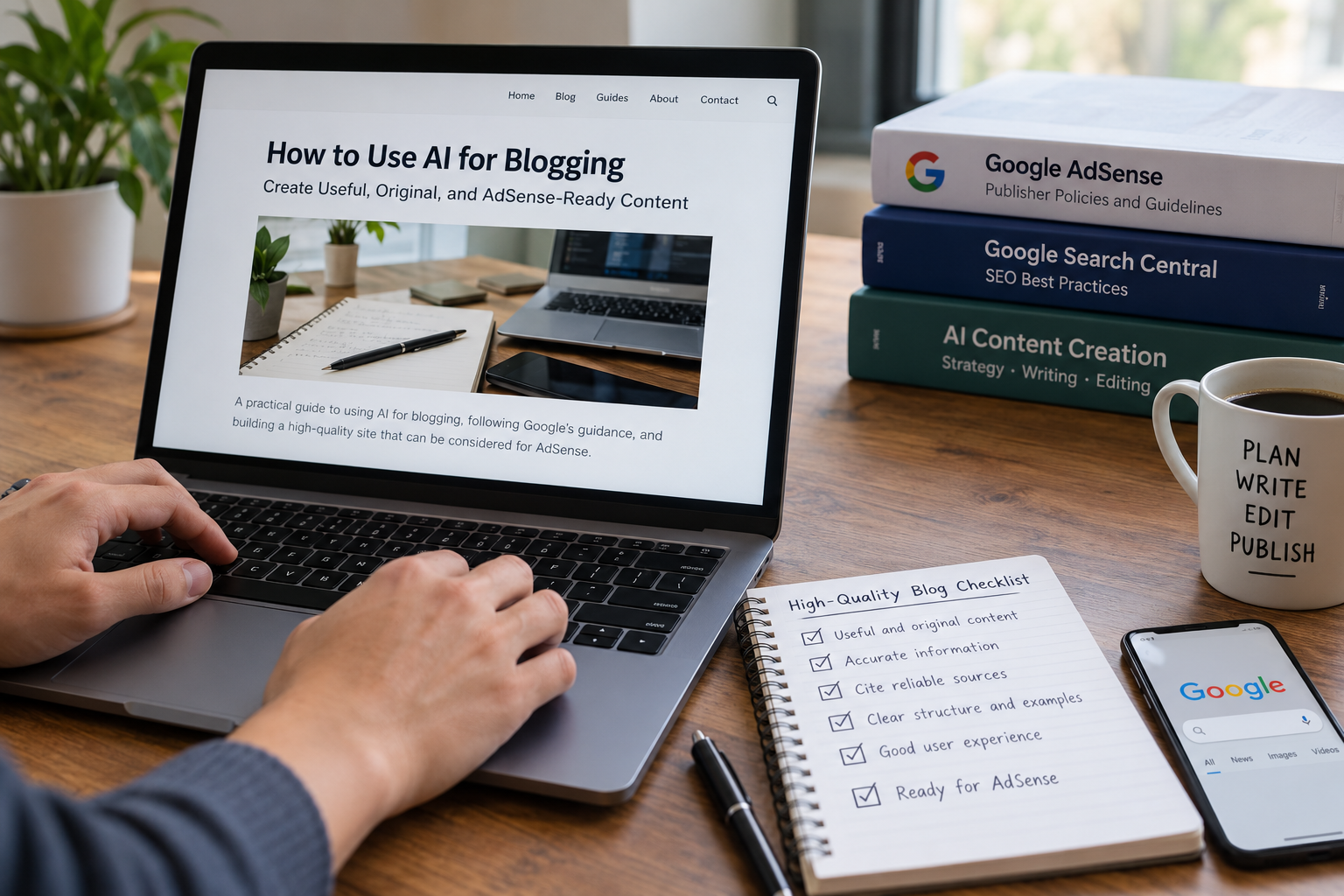
A new publisher can spend a week generating fifty articles and still have a site that gives readers no reason to return. That is the mistake worth avoiding when you use AI for blogging. The question is not whether a machine touched the draft. It is whether the finished page is accurate, original, useful and clearly made for an actual reader.
This guide separates two things bloggers often mix up: Google Search guidance, which concerns how content may appear in search results, and AdSense requirements, which concern whether a site may participate in Google's advertising programme. Good search content does not guarantee an AdSense approval, and AdSense approval does not guarantee traffic.
Is AI-written content automatically against Google's rules?
No. Google's guidance on generative AI content says AI can help with tasks such as research and structure. The problem arises when many pages are created primarily to manipulate search rankings rather than help people. Google's spam policies specifically address scaled content abuse regardless of whether the material was produced by humans or automation.
That distinction matters. A carefully edited article with first-hand experience, checked evidence and useful examples is different from a thousand near-identical pages that simply swap city names or product keywords.
What AdSense actually asks publishers to provide
Google's AdSense readiness guidance emphasises unique content, relevance, original value and a good experience for visitors. The broader eligibility page includes policy compliance and account eligibility. Google's documentation does not promise approval for publishing a particular number of words or posts.
A useful site should have understandable navigation, substantial original articles, functional pages and clear information about the publisher. Check the current applicable policies before applying. Privacy notices and disclosures may also be needed depending on data collection, advertising tools and audience location.
Do not confuse word count with quality
A 2,000-word guide can be thin if it repeats the same definitions for ten paragraphs. A shorter page can be valuable if it solves a precise problem with a correct worked example. When deciding whether an article is complete, ask: Does it answer the reader's actual question? Can a visitor use the information? Are the caveats and next steps clear?
For a comparison article, explain what you actually compared and how. For a tutorial, show the setup, steps, expected result and common errors. For a reported story, link to primary evidence and distinguish confirmed facts from company announcements. If you have not personally tested a tool, do not call the article a hands-on review.
A simple editorial process for AI-assisted articles
- Choose one real reader problem, not a list of random high-volume keywords.
- Read existing authoritative material to understand the question and what is missing.
- Create your own structure, original examples and useful decisions or checklists.
- Verify statistics, quotations, product features and source URLs from original pages.
- Edit the tone so it is clear, specific and free of repetitive filler.
- Add an accurate headline, a useful introduction and relevant links.
- Review the result on a phone before publishing.
- Revisit the article when the underlying facts change.
Using established articles for background research is normal. Copying paragraphs, paraphrasing another publisher page by page, or stitching together scraps from multiple sources without adding value is not a publishing strategy. It can create copyright and quality problems.
The kind of original value readers notice
Suppose you publish a guide titled 'How to use AI for Excel'. A thin article lists ten generic benefits. A useful article shows correct formulas, explains what happens when a cell is empty, includes an edge case and tells the reader how to check the answer. That extra work is the article.
For a business guide, original value may mean a decision checklist and a realistic fictional scenario clearly labelled as an example. For a product review, original value should ideally include authentic testing, limitations and evidence; never invent screenshots or performance scores.
Make links useful rather than decorative
Citing a genuine primary source helps readers verify what you wrote. Link to the exact documentation page or published report, not just the brand's home page. These are outbound citations. They are not backlinks to your own website. Genuine inbound links are earned when another publisher independently decides your article deserves a reference.
Avoid purchasing bulk links or filling posts with unrelated affiliate promotions. Relevant links should help a reader solve the problem, not create the appearance of authority.
Basic on-page SEO without overdoing it
Give each article a distinct descriptive title and a readable URL. Write a unique meta description that accurately explains the page. Use useful subheadings and descriptive link text. Add internal links where they genuinely connect topics. If you use images, make sure you have rights to publish them and provide meaningful alt text where appropriate.
Google's documentation on snippets explains that meta descriptions are one possible source for snippets, not a way to control exactly what Google displays. A keyword repeated ten times is not an improvement over a naturally written answer.
What to check before applying for AdSense
Read your site like a stranger. Can you find articles from the home page? Are there broken menus? Do important pages contain real content? Do you have an identifiable publication, contact route and privacy information appropriate to your setup? Are articles original, accurate and distinguishable from each other?
Then check technical fundamentals: indexable pages, working canonical URLs, a reachable sitemap and no accidental 'noindex' settings. Google's sitemap guidance explains submission through Search Console, but a submitted sitemap is only a discovery signal—not a ranking promise.
What about a '100% human' article?
Readers cannot verify a claim about a writer's production process merely from a badge or a few intentional typos. Deliberately introducing spelling mistakes does not create expertise or original value. A more credible approach is to be accurate about how the work was made, apply meaningful editorial review and add real insight.
Google's people-first content guidance suggests explaining the role of automation where readers would reasonably want to know. That can be done in an editorial policy without awkwardly announcing the tool behind every ordinary sentence.
Frequently asked questions
Do I need a minimum number of posts to get AdSense approval?
Google does not provide a universal guaranteed post count in the eligibility guidance cited above. Focus on site readiness and original content instead of an arbitrary threshold.
Can ten well-researched posts generate daily US or UK traffic?
They can give a site useful pages to index and share, but traffic depends on search demand, competition, authority, links and distribution. No honest writer can promise daily clicks from a batch of articles alone.
Can I republish a competitor's article after rewriting it?
Changing the wording does not automatically make copied analysis original. Research the subject, contribute your own structure and examples, cite genuine sources and avoid reproducing protected material.
Useful writing is not a trick for AdSense approval. It is the reason a visitor might stay, trust the page and come back.