
Copy of What Are AI Agents? How They Work, What They Can Do, and Where They Fit
AI agents can plan tasks, use tools, make decisions, and complete multi-step workflows. Here is a practical explanation of how they work and when to use them.
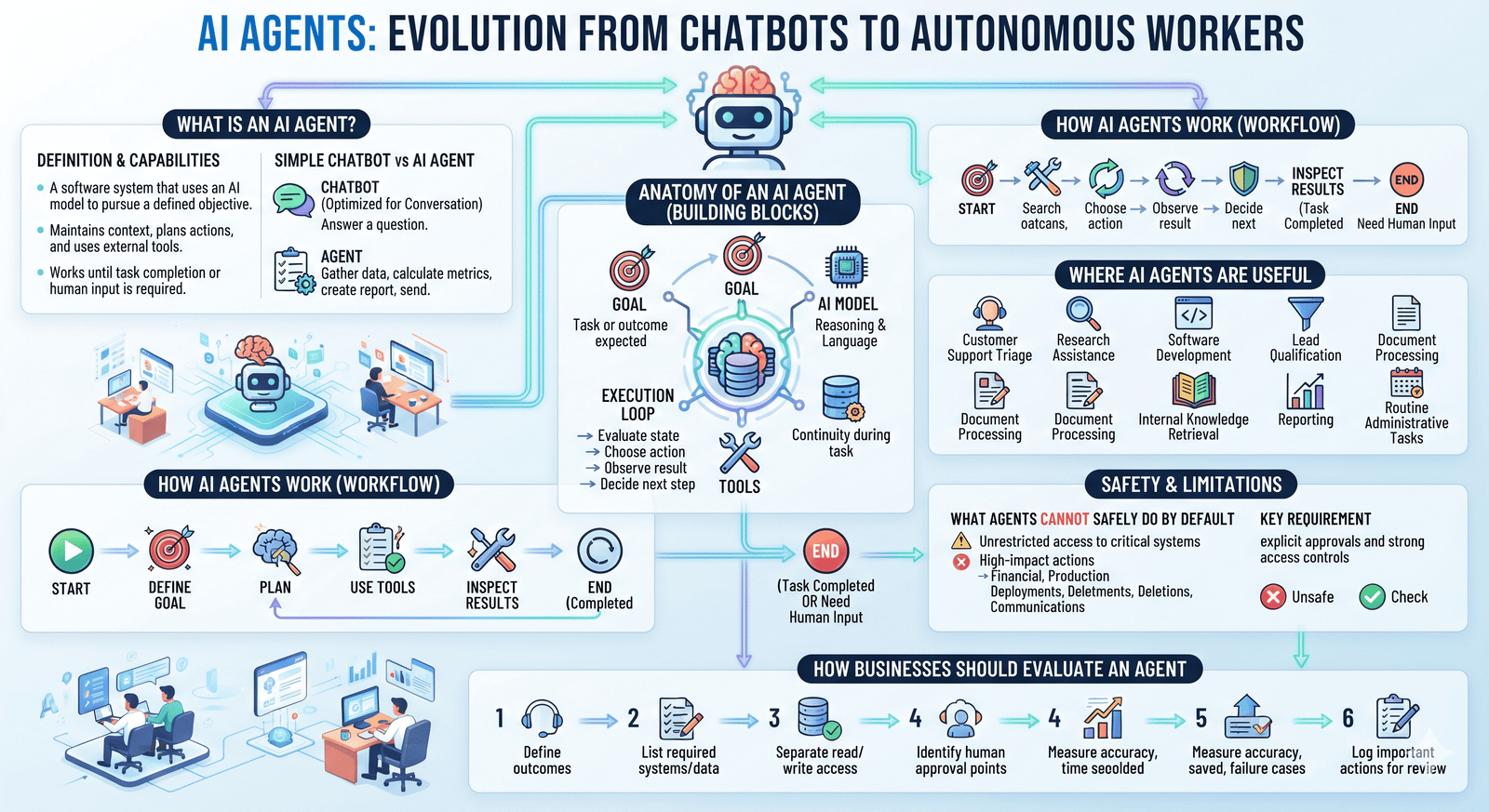
AI agents are one of the most important developments in modern artificial intelligence because they move beyond simply generating an answer. An AI agent can be designed to understand a goal, plan a sequence of actions, use software tools, inspect results, and continue working until a task is completed or human input is required.
What is an AI agent?
An AI agent is a software system that uses an AI model to pursue a defined objective. Instead of responding to one isolated prompt, an agent can maintain context, decide what action to take next, and interact with external tools such as databases, APIs, browsers, calendars, code environments, or business applications.
A simple chatbot might answer, “Here is how you can create a sales report.” An agent could potentially gather sales data, calculate the required metrics, create the report, and send it to the appropriate people, depending on the tools and permissions it has been given.
How AI agents work
Most agentic systems combine several building blocks:
- Goal: the task or outcome the system is expected to achieve.
- AI model: the reasoning and language component used to interpret information and choose actions.
- Memory or context: information needed to maintain continuity during a task.
- Tools: external capabilities such as APIs, search, databases, code execution, or business software.
- Execution loop: a process that evaluates the current state, chooses an action, observes the result, and decides what to do next.
- Guardrails: permissions, validation rules, human approvals, and limits that reduce unwanted actions.
AI agents vs. traditional chatbots
A chatbot is generally optimized for conversation and response generation. An agent is designed around completing an objective. The distinction is not absolute, but it is useful when evaluating AI products.
| Capability | Typical chatbot | AI agent |
|---|---|---|
| Answer questions | Yes | Yes |
| Plan multiple steps | Limited | Core capability |
| Use external tools | Sometimes | Usually important |
| Take actions | Limited | Often |
| Operate toward a goal | Usually conversational | Yes |
Where AI agents can be useful
AI agents can be useful when a workflow contains repetitive decisions and multiple software steps. Examples include customer-support triage, research assistance, software-development workflows, lead qualification, document processing, internal knowledge retrieval, reporting, and routine administrative tasks.
What AI agents cannot safely do by default
An agent should not automatically receive unrestricted access to important systems. Financial transactions, production deployments, deletion of records, customer communications, and other high-impact actions may require explicit approvals and strong access controls.
The key question is not whether an agent can perform an action, but whether it should be permitted to perform that action without human review.
How businesses should evaluate an AI agent
- Define the exact business outcome.
- List the systems and data the agent needs.
- Separate read access from write access.
- Identify actions that require human approval.
- Measure accuracy, completion rate, time saved, and failure cases.
- Log important actions so they can be reviewed.
Final takeaway
AI agents are best understood as AI-powered software workers that can combine reasoning with tools and actions. They can be valuable for structured, repeatable workflows, but reliable deployment requires clear permissions, testing, monitoring, and human oversight where the consequences of mistakes are significant.