
Using AI to Improve Your CV or Resume Without Inventing Experience
A step-by-step approach to improving a US resume or UK CV with AI while keeping every accomplishment true.
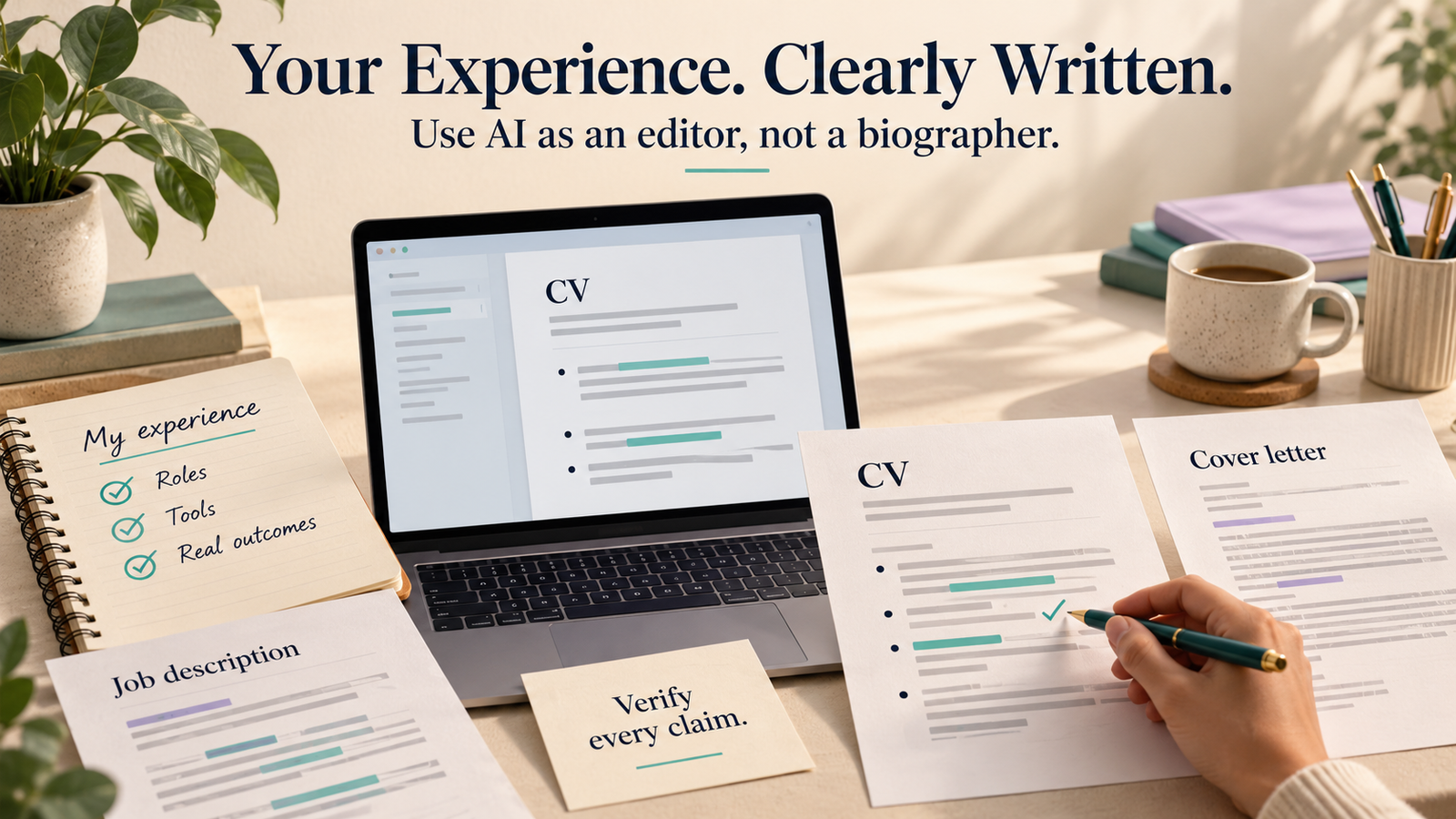
There is a particular kind of CV that gives itself away immediately. Every line is 'results-driven', every candidate is 'passionate', and the achievements are so polished that they could belong to anybody. AI can produce that document quickly. It is not a good reason to use it.
The better job for an AI assistant is editor, not biographer. You provide the experiences. It helps you explain them clearly and match the employer's language without making facts up.
First, make a private evidence sheet
Before drafting, write down the jobs you have actually done, dates, tools, responsibilities and outcomes you can defend in an interview. Include uncertain figures with a question mark rather than deciding later to present them as exact. If you cannot verify a 30% improvement, describe the process you improved without the number.
A useful source sheet might contain: 'Helpdesk analyst; handled ticket triage; used ServiceNow; created troubleshooting steps for recurring VPN incidents; handed off unresolved issues to networking team.' That is enough to create a credible bullet. You do not need to invent a company-wide transformation.
Step 1: Ask for a job-description comparison, not a rewrite
Copy the public job description and a redacted version of your current CV. Then ask:
Compare this job advert with my existing CV. Show the five most relevant responsibilities, where my CV already provides evidence and where it does not. Do not add any skill, employer, result or qualification that is absent from my information. Ask me questions about gaps instead of filling them in.
This changes the process from 'make me sound impressive' to 'show what I need to explain better'. You can often improve an application by moving one relevant achievement higher, not by writing a new paragraph of buzzwords.
Step 2: Convert duties into precise achievements
Consider the line: 'Responsible for handling customer tickets.' It describes a duty but not what you did. A clearer version might be: 'Investigated incoming support tickets, documented the likely cause and escalated complex network issues with supporting logs.'
The second sentence is stronger because it is concrete. It does not claim that tickets fell by 50% or that you led a team. If you have real measurements—such as monthly case volume or an agreed service level—add them after checking your evidence.
Prompt: 'Rewrite each bullet in active language. Start with a specific action verb, preserve all factual details, avoid unsupported numbers and show me anything that needs verification.'
Step 3: Use the employer's terms where they honestly fit
A job listing may say 'stakeholder communication', while your CV says 'updated project managers and customers'. That can be an honest alignment. A listing may demand Kubernetes experience while you have only watched a course. Don't change 'trained in Kubernetes basics' into 'deployed enterprise clusters'.
A common misunderstanding is that stuffing a document with keywords guarantees success with an applicant tracking system. Different employers and recruitment systems work differently; there is no universal magic score. Clarity, relevant terminology, a readable structure and truthful evidence are more dependable than keyword repetition.
Step 4: Check differences between a US resume and a UK CV
US employers generally use the term resume, while UK employers generally use CV for standard job applications. Both vary by sector and seniority. A UK academic CV may be much longer than a business CV. Use the conventions of the employer and role, not a universal template.
Review spelling and wording. A UK employer may expect 'organised', 'optimised' and 'programme' in the appropriate context; a US employer may prefer 'organized', 'optimized' and 'program'. Neither version should read like a translation exercise. Local conventions matter more than randomly changing words.
Also remove irrelevant personal details and check local expectations before including a photo, date of birth or other sensitive information. Employer instructions take priority.
Step 5: Write the cover letter around one real reason
A convincing cover letter answers three questions: Why this role? What evidence proves you can do the work? Why this employer specifically? The last one requires research.
Instead of: 'I am thrilled to apply to your esteemed organisation', try: 'Your team is hiring someone to support cloud infrastructure and investigate production incidents. In my current role, I troubleshoot service issues and coordinate escalations with engineering teams.' This is only an example. Replace it with what is genuinely true for you.
Prompt: 'Draft a 220-word cover letter using only the experience below. Mention one specific requirement from the public advert and connect it to one real example I provide. Avoid flattery, clichés and invented knowledge about the employer. Flag missing facts.'
Step 6: Run a final interview-proof check
Read each sentence and ask: Could I explain this if the interviewer asks for details? If not, edit it. Check dates, titles, certifications and metrics. Remove skills you cannot demonstrate. Read the first five lines aloud to see whether they sound like something you would actually say.
The Open University's careers guidance specifically stresses accuracy, authenticity and employer rules when using generative AI. UK careers publisher Prospects similarly encourages personalisation and checking AI-generated documents.
Seven warning signs in an AI-edited CV
- Every bullet begins with 'spearheaded', 'leveraged' or 'revolutionised'.
- Percentage improvements appear without supporting evidence.
- Skills from the job advertisement show up as if you have used them professionally.
- Dates and job titles have changed.
- A short internship is written as a senior leadership role.
- The cover letter claims you love a company's values but never names anything specific.
- You would struggle to explain a sentence in an interview.
Frequently asked questions
Will recruiters reject a CV simply because AI helped edit it?
There is no universal rule. Check employer instructions. AI-assisted proofreading may be allowed where generating assessment answers or making false claims is not. The Open University advises applicants to review employer policies.
Should I upload my full CV to a free chatbot?
Consider the personal information in it and the tool's data controls. You can often use a redacted CV or a list of responsibilities for editing help.
Can AI create an ATS-friendly format?
It can suggest a clear layout and help remove clutter. No prompt guarantees compatibility with every applicant tracking system; follow the employer's requested file type and application process.
The final CV should contain more of *your* evidence and less generic language. If AI leaves the document sounding more like a stranger, start over from the facts.