
How to Write Better AI Prompts: A Five-Part Template That Works
A simple five-part prompt structure with examples for emails, research, customer support and planning tasks.
People tend to blame the AI when an answer comes back vague. Sometimes the answer is genuinely bad. Other times the request was something like 'write a good email' and the system had to invent what 'good' meant.
You do not need to become a prompt engineer to fix that. Most everyday requests get better when you provide a few details a colleague would reasonably ask for. The trick is knowing which details actually matter.
The five parts of a useful prompt
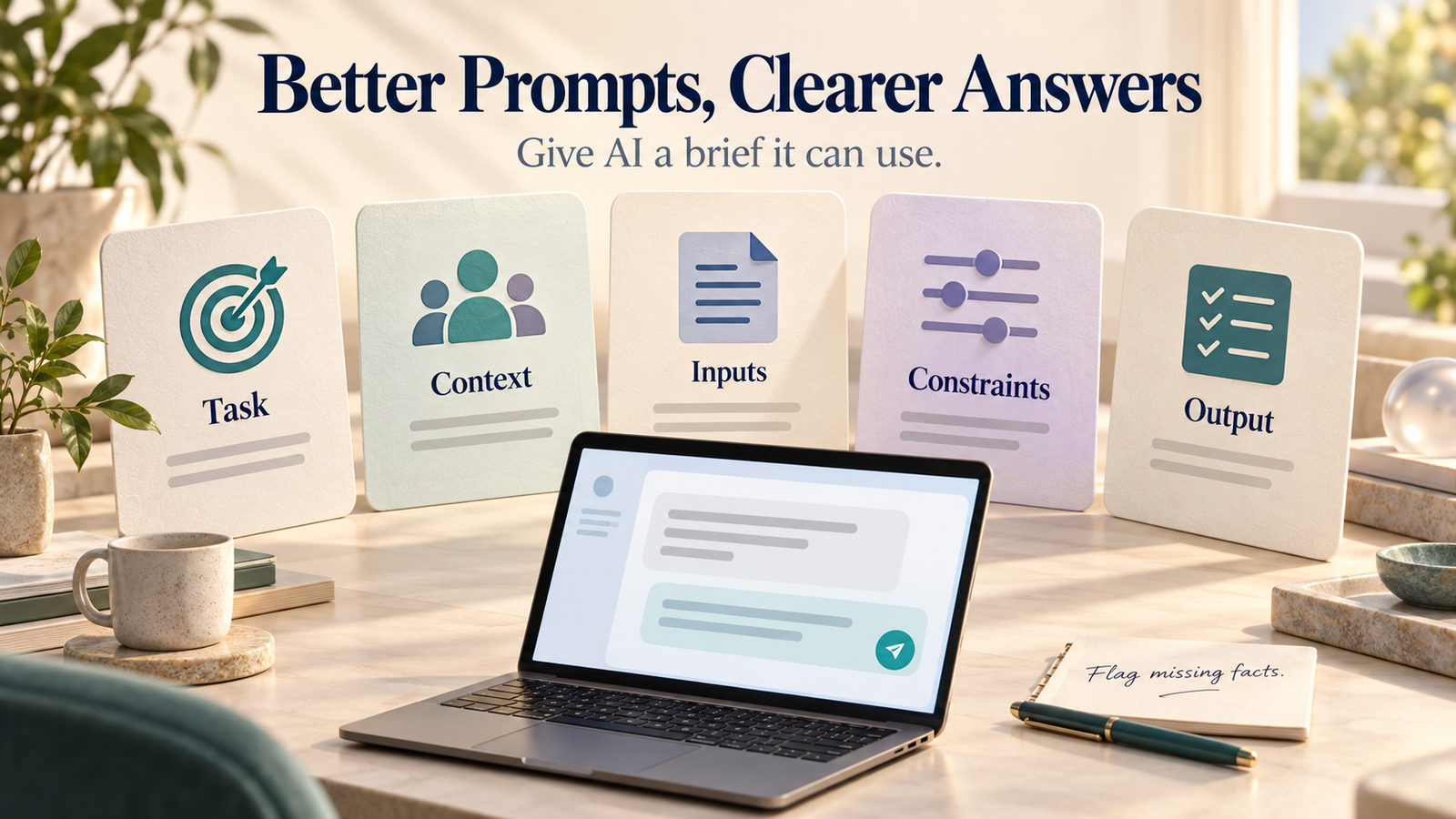
Use Task + Context + Inputs + Constraints + Output. It is not a secret formula, and you will not need every part on every request. It is simply a dependable way to turn an unclear instruction into a small, workable brief.
- Task: What should the assistant actually do? Draft, compare, explain, classify, revise or brainstorm?
- Context: Who is this for, and why does it matter? Give the audience and situation.
- Inputs: What known information should it use? Include the facts or a safe sample.
- Constraints: What must it avoid or preserve? Set tone, length, rules and boundaries.
- Output: What should the answer look like? A table, short email, checklist or numbered steps?
This approach is consistent with OpenAI's prompting guidance, which recommends clear, specific instructions and refining prompts in response to results.
Example one: the email that sounded like everybody else's
Weak request: 'Write a follow-up email to a customer.'
Stronger request:
Task: Draft a follow-up after a product demo. Context: The reader is an operations manager at a small manufacturing business. Inputs: We discussed inventory visibility and agreed that I would send a summary. Constraints: 120 words maximum; friendly but professional; no exaggerated claims; no prices, dates or promises I have not supplied. Output: A subject line and a ready-to-edit email.
The better prompt does not force one perfect result. It gives the model enough information to write something relevant and makes unsupported details less likely.
Example two: research without imaginary statistics
Weak request: 'Tell me how AI is changing hiring.'
Stronger request:
Explain three practical ways employers use AI in recruitment, focusing on US and UK readers. Separate common use cases from claims needing verification. Cite original sources for statistics, and say 'source needed' where you cannot verify one. End with questions a job applicant should ask. Do not claim every company uses the same system.
Notice how the prompt asks for distinctions, not simply more text. A well-designed research request gives the reader a map of certainty and uncertainty.
Example three: helping with a messy project
Suppose a support team has trouble handing incidents between shifts. You could ask for 'a better process'. Or give the model the actual failure points: missing incident owners, inconsistent severity labels and unclear next action.
Design a simple handover checklist for a five-person IT support team. Inputs: each ticket has an ID, business impact, current status, last action and next owner. Constraints: no extra software, maximum eight checklist items, and no invented team roles. Output: a checklist followed by one worked example with fictional data.
A concrete prompt is easier to evaluate. You can look at the result and say exactly which part helps and which part does not.
Context is useful, but more context is not always better
A common mistake is pasting a ten-page background document into a prompt when three lines would do. Extra material may introduce contradictions, distraction or sensitive details. Summarise the problem first. Add the supporting material only when the answer genuinely depends on it—and only when you are permitted to share it.
If you need the assistant to work from a long document, identify the decisive sections. If accuracy matters, ask it to mark facts that need verification. If tone matters, provide a short example you are allowed to use, rather than asking for a vague 'human' style.
Tell the assistant what not to invent
This single sentence can save substantial cleanup: 'If a needed fact is missing, use a placeholder or identify the gap instead of inventing it.' Use it for meeting minutes, job applications, sales proposals and content research.
A second useful sentence is: 'Separate confirmed information from suggestions.' Without it, a hypothetical example may be written in the same voice as an established fact.
Iteration is part of prompting, not evidence of failure
Your first answer is a draft. Give targeted feedback rather than starting from scratch:
- 'Keep the structure, but reduce the first paragraph to two sentences.'
- 'The second example assumes a paid plan; replace it with a plan-neutral workflow.'
- 'This sounds too promotional. Replace the claims with direct, practical explanations.'
- 'Show which numbers came from my input and which you calculated.'
The model may still make mistakes. But focused corrections are easier than rewriting the entire instruction every time.
A short template to save
I want you to [task] for [audience/purpose]. Here is the information you may rely on: [facts or sample]. Keep [important constraints]. Do not invent [missing details]. Format the result as [output]. Before finishing, flag assumptions or points that require checking.
Try it on three different tasks and notice where it helps. For simple questions, you may need only one sentence. For serious work, the boundaries matter far more than clever wording.
Common questions
Do I need to assign a role such as 'act as an expert'?
Sometimes a role helps establish audience or style. It does not make the answer factually verified or give the model real professional credentials.
Do longer prompts always perform better?
No. They can include useful constraints, but they also create opportunities for confusion. Prefer enough detail to define the task, then refine.
Should I demand that every AI answer include citations?
For fact-sensitive work, ask for traceable sources and verify them yourself. For a fictional brainstorming task, citations may be irrelevant.
The best prompt is not the one with the most sophisticated vocabulary. It is the one that makes a wrong answer easier to notice.