
AI Meeting Notes: How to Capture Decisions Without Trusting Every Transcript
How to use AI meeting notes responsibly and turn a noisy transcript into verified owners, decisions and next steps.
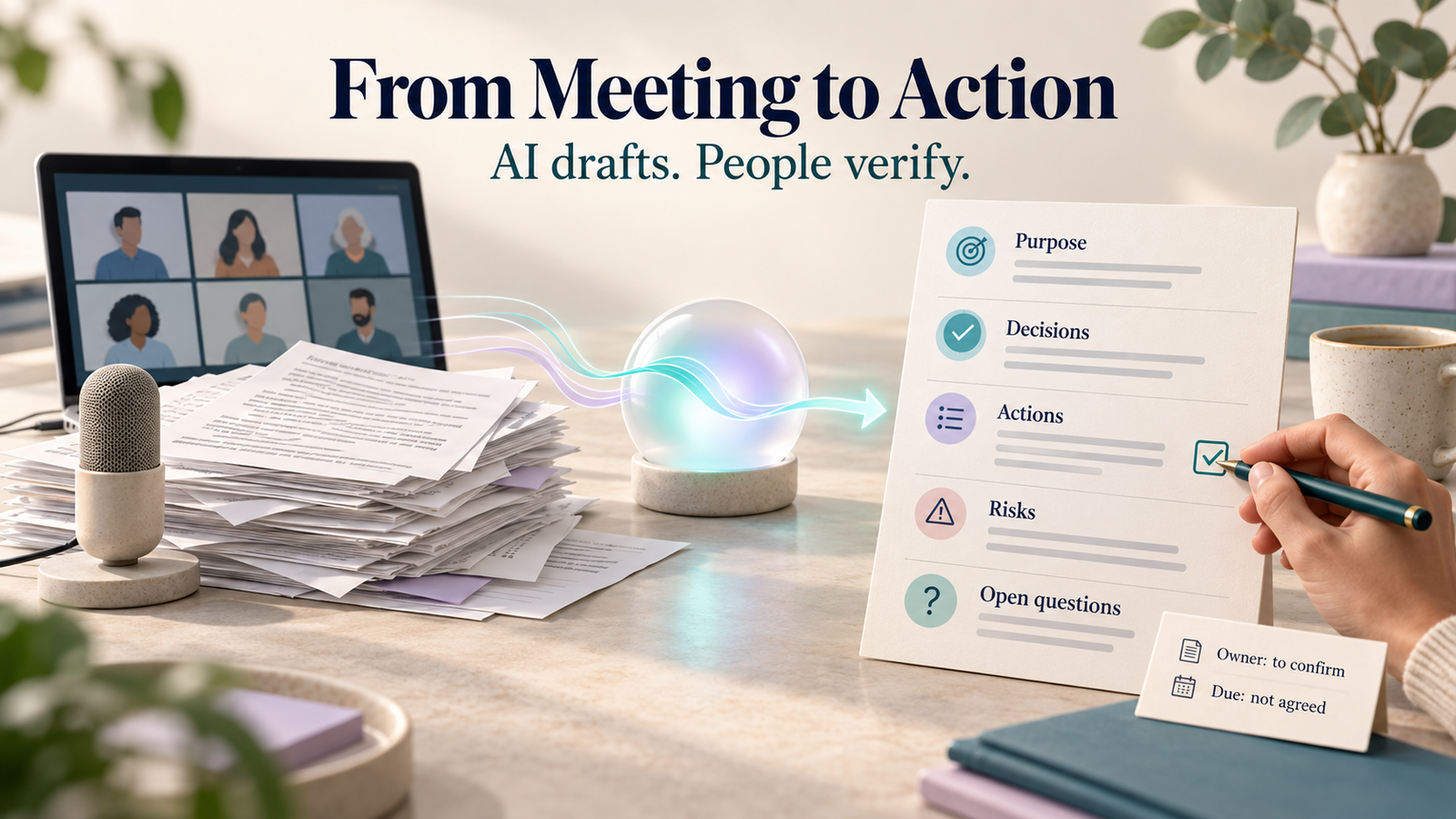
Anyone who has left a meeting with six pages of transcript and no clear next action understands the problem. A transcript records what people said. A useful meeting note records what the group decided, who owns the work and when it needs attention. Those are different things.
AI note-taking can bridge that gap, but it can also assign a task to the wrong person or turn a tentative suggestion into a final decision. The practical answer is a workflow with one human review at the end.
Decide whether the meeting should be captured at all
Start with participant expectations and company policy. Meeting transcription can capture personal information, client discussions and sensitive decisions. Explain which tool is being used, who can access the result and how the notes will be shared. Follow applicable consent, employment and data-protection requirements; rules and organisational policies differ across jurisdictions.
Google Meet's Take notes for me documentation describes eligibility and settings, including participant notices and administrator-controlled consent features. Microsoft's Teams recap guidance explains how features may use transcripts and how access and retention follow organisational policies. Do not assume a note-taking feature is enabled for every account.
Use a better structure than 'summary of discussion'
I recommend five sections for routine project meetings:
- Purpose: why the meeting happened.
- Decisions: decisions actually agreed, not ideas under discussion.
- Actions: task, named owner and due date when explicitly stated.
- Risks or blockers: problems that could change the plan.
- Open questions: items not resolved in this meeting.
This format makes a note useful to someone who did not attend. It also makes errors easier to find than a long, polished paragraph.
An example of a good action item
Weak: 'The team discussed website changes, and Sarah will coordinate.'
Better: 'Action: Sarah to collect the final homepage screenshots from the design team. Due date: not agreed. Decision still needed: whether the new header replaces the existing mobile navigation.'
The names and task above are fictional. The important difference is that the second version refuses to invent a deadline or suggest that a disputed design is approved.
A prompt for turning meeting material into usable notes
Read these authorised meeting notes or transcript. Produce sections for confirmed decisions, assigned actions, risks and unresolved questions. For every action include the owner and due date only if stated explicitly. Mark ambiguous speaker attribution as 'owner to confirm'. Quote a short supporting phrase for major decisions where possible. Do not convert a proposal into an agreed decision.
If your meeting tool already creates an AI summary, use this structure as an editing checklist rather than uploading the same confidential transcript to a second service. Moving data between tools may create extra privacy exposure.
Review the two errors that cause the most work later
False decisions: Somebody says, 'We could launch next Tuesday.' The summary says, 'Launch scheduled for Tuesday.' That is a serious change in meaning. Listen to the relevant section or ask the meeting owner before publishing it.
Wrong ownership: Two people discuss a task and the assistant names one of them as owner. If nobody agreed responsibility, leave the owner blank. A clean 'unassigned' entry is better than false accountability.
Check dates, numbers, customer names and action ownership before sharing. Automatic speech recognition may confuse similar names or specialist terminology. Provider documentation also notes that AI-generated notes can be incomplete or inaccurate.
Make the follow-up a two-minute ritual
Send notes after a quick owner review, with a subject line that names the meeting and date. Ask attendees to flag corrections. Move confirmed tasks into the team's existing task system rather than leaving them buried in an email attachment.
Keep a small decision register: decision, date, owner, link to the approved record. The meeting summary is evidence of the conversation, but the register should show which version was approved. This is especially helpful when projects run over several months and old decisions get reopened.
Should you use Google Meet, Teams or a separate AI note taker?
Use the platform your organisation already supports unless there is a real reason to add another service. Built-in tools may align better with identity, retention and access settings already used by your team. A separate tool may offer different features but will need its own security and permissions review.
Compare tools on the points that matter: supported language, note quality for your typical meeting, speaker attribution, participant notices, access controls, export options and the ability to correct summaries. Price and availability can change, so check vendor pages before choosing a subscription.
A simple quality score for the finished notes
After the meeting, ask four questions: Are decisions separate from ideas? Does every action have a confirmed owner? Are due dates supported by what was said? Can attendees correct mistakes? If any answer is no, the summary is not finished.
A meeting note should save the team from holding another meeting to clarify the previous one. It cannot do that if everyone treats the first AI draft as an official record.
Frequently asked questions
Can AI notes replace formal meeting minutes?
Not automatically. Formal minutes may require a specific approval process, particularly for boards and regulated organisations. AI notes can support the preparation, but an authorised person should verify and approve the record.
Do meeting participants need to know AI is taking notes?
Follow the product's participant notice and consent features, applicable law and your organisation's policy. Transparency is a sensible minimum even when the precise legal requirement differs.
What if two people disagree about the decision?
Mark it as disputed or unresolved. A summary should not manufacture agreement where none exists.