
RAG vs Fine-Tuning: What Small Businesses Actually Need for an AI Assistant
An approachable comparison of retrieval-augmented generation and fine-tuning, with practical cases, costs to consider and safety checks.
A small business wants a chatbot that answers questions about its latest products, internal procedures and customer support documents. Someone suggests fine-tuning a model. Someone else says the answer is RAG. The discussion gets technical before anyone asks the basic question: what must the assistant know, and how often does that information change?
That question is the starting point. Retrieval-augmented generation (RAG) and fine-tuning solve related but different problems. You can use both, but many teams should start with the simpler option.
The plain-English difference
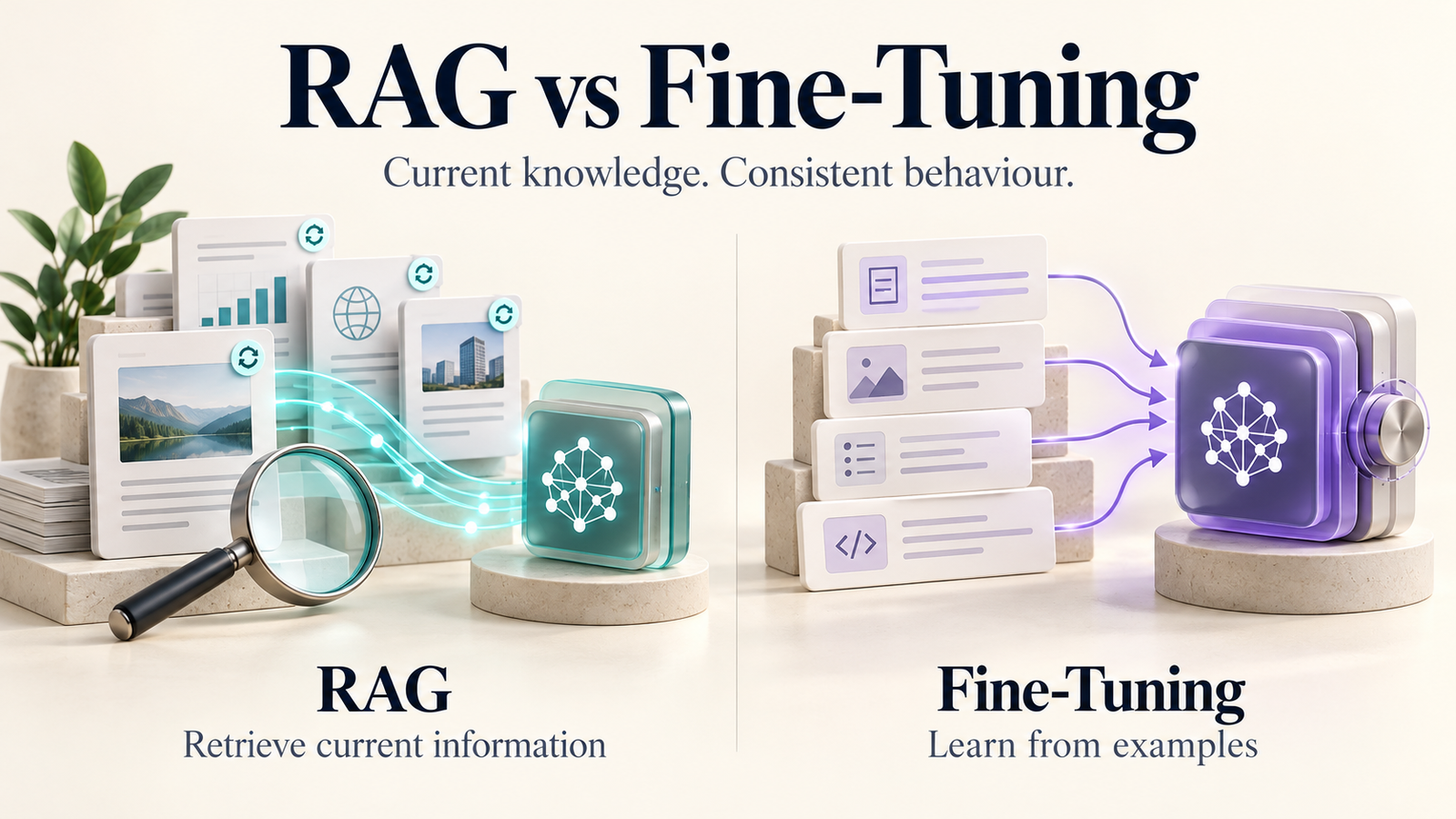
RAG retrieves relevant information from documents or a knowledge base when a question arrives, then gives that material to a language model to help answer. The underlying model is not trained anew every time you update a price list.
Fine-tuning trains an existing model further on task-specific examples to influence how it behaves or performs a task. It can be useful for a stable format, classification pattern or specialised behaviour. It is not automatically a good way to keep a live catalogue current.
Microsoft's RAG documentation draws essentially this distinction: retrieval for grounded, changing knowledge and fine-tuning for behaviour or task performance.
Picture two practical requests
Request A: 'What is our current warranty process for the UK market?' The answer lives in a versioned procedure document, and that document changes when the policy changes. RAG is a natural candidate because the assistant can retrieve the latest approved procedure and cite it.
Request B: 'Classify each incoming support ticket into one of our five custom categories.' You have many high-quality labelled examples and a consistently defined task. Fine-tuning might help if prompts and ordinary classification approaches are not reliable enough.
Neither example guarantees success. Retrieval can bring back the wrong document; fine-tuning can inherit errors from the training set. Both need evaluation.
How a basic RAG system works
- Gather permitted source documents and record their owners, dates and access permissions.
- Split long documents into useful sections, often called chunks.
- Index the sections for search. Depending on the system, this may use keywords, vector embeddings or both.
- When a user asks a question, retrieve the most relevant sections they are authorised to access.
- Ask the model to answer using those sections and show the source document or reference.
- Verify the result and log unanswered or incorrect questions for improvement.
Notice that the hard work is not merely calling an AI model. It is preparing documents, enforcing permissions and checking whether the correct passage was retrieved. Microsoft's RAG design guidance focuses heavily on those choices.
What fine-tuning changes
Fine-tuning adjusts model weights using examples. That can improve consistency for particular tasks where you can define a clear target and assemble enough representative training data. It also means managing a training dataset, evaluation cases and a process for maintaining the resulting model.
If the business updates a refund policy tomorrow, you do not want to rely on remembering to retrain before staff receive accurate answers. A maintained source repository and retrieval process is generally a more straightforward way to reflect approved changes.
A comparison for buying decisions
- Frequently updated product documents: Start by evaluating RAG.
- Answers that need traceable source references: Start by evaluating RAG, while remembering citations can still be wrong.
- Stable, repeated classification with labelled examples: Test prompt-only and traditional approaches; then consider fine-tuning if justified.
- A specialised writing style or repeatable output format: Try clear prompts and examples first; fine-tuning may be a later optimisation.
- Private knowledge with strict user permissions: RAG can help, but access control must be enforced in retrieval, not left to the model's discretion.
If a vendor says either method makes hallucinations impossible, that is a reason to ask harder questions.
The costs nobody includes in the first slide
For RAG, count document preparation, search infrastructure, embeddings or indexing, model usage, monitoring and updating the knowledge base. For fine-tuning, count curating labelled examples, training, storage, inference, evaluation and periodic retraining where needed. Costs vary greatly by provider, usage and architecture. A fixed '$ per chatbot' claim is not meaningful without those assumptions.
An inexpensive pilot can use a small, controlled knowledge base and a set of fifty real questions—cleared of personal information. Measure factual accuracy, citation quality, permission boundaries, response time and cost per successful answer. Compare those results with a simple prompt-only baseline.
Security is part of the architecture
Retrieved documents are not automatically trustworthy instructions. A malicious or compromised document can contain text trying to redirect the assistant. OWASP's prompt-injection guidance warns that RAG and fine-tuning do not eliminate these risks.
Keep user permissions in the retrieval layer. Separate the model's instructions from untrusted document content. Validate outputs before taking actions such as sending emails or updating orders. Do not let an assistant invent a source because an index returned nothing.
A decision framework for a small team
Ask five questions: Is the knowledge changing weekly? Must answers cite company documents? Do different users have different access rights? Is the desired change about *knowledge* or *behaviour*? Can you define a measurable quality test?
If the first two answers are yes, a carefully scoped RAG pilot is sensible. If the need is stable behaviour and you have representative labelled examples, evaluate fine-tuning after testing simpler alternatives. If the task is deterministic—like calculating tax from a published rate—ordinary software logic may be safer than either.
Frequently asked questions
Can RAG use private files?
Yes, in an appropriately designed system, but upload permissions, storage, retrieval access and provider policies all need review. 'Private' is an architectural requirement, not a button label.
Does fine-tuning teach a model the newest company facts?
Training can influence a model's responses using supplied examples, but it is not a reliable replacement for a maintained and queryable source of current facts.
Can one application use both?
Yes. A model tuned for a stable task can also receive retrieved knowledge when answering. Do not add complexity unless tests show a practical improvement.
Most teams do not need the most impressive architecture diagram. They need an assistant that can say 'I don't have enough evidence' when the right document is missing.